


Framework governance
EEC Professional Certifications – formally known as the EEC Professional Certifications Framework – has been designed to be impartial and meet the needs of customers, energy services providers, governments and the general public. As with all EEC activities, the EEC Board is ultimately responsible for the proper management of the Framework.
The Board delegates day-to-day administration of the Framework to the Secretariat.
The Secretariat is housed within the EEC and is the primary point of contact for candidates, certified professionals and tradespeople, and other stakeholders.
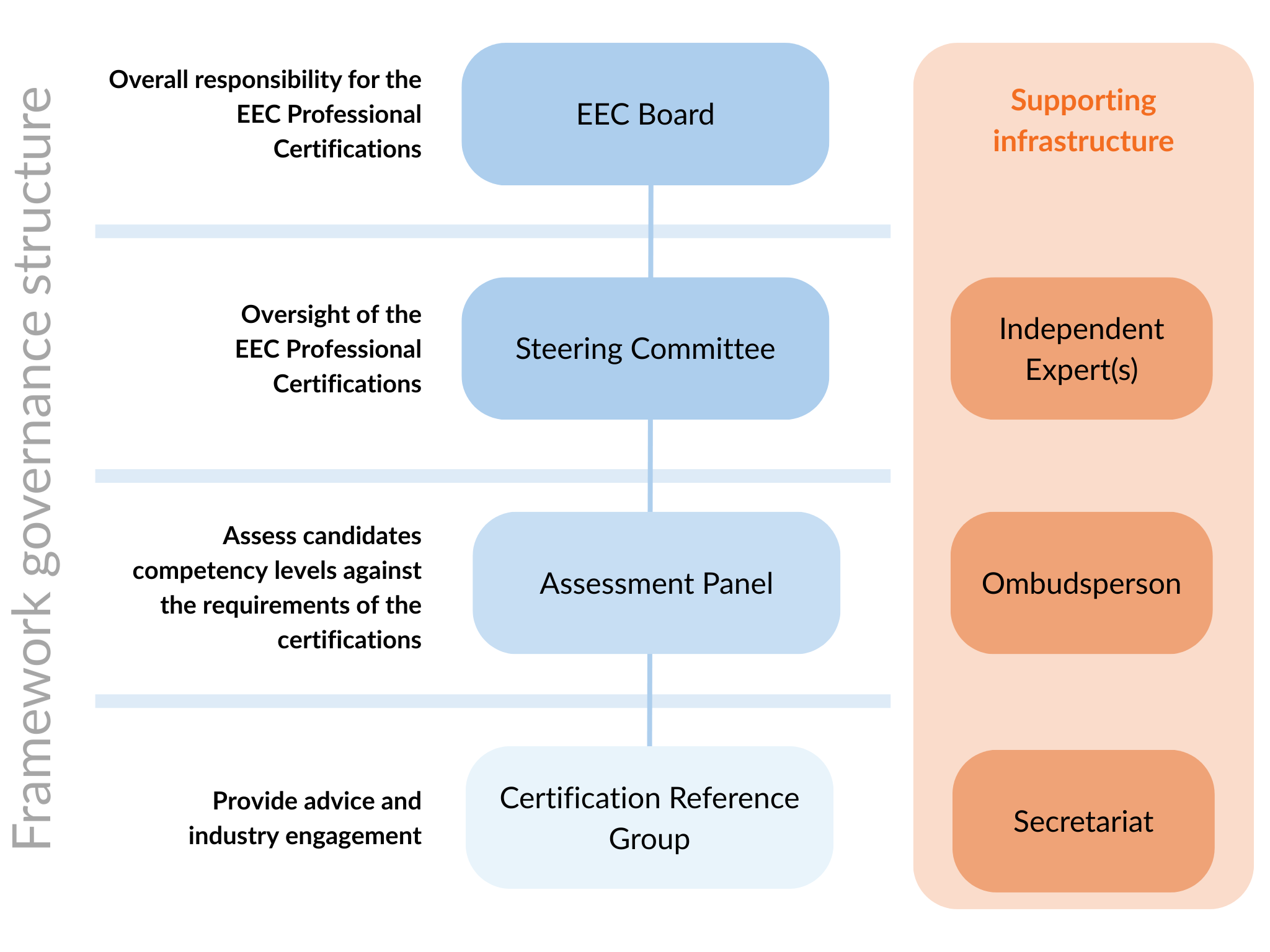
To ensure impartiality, transparency and independent oversight, the EEC Board has appointed the following bodies that have a central role in the administration and oversight of the Framework:
- A Steering Committee comprised of members from industry and government, as well as other relevant experts. This body oversees the Secretariat and Certification Reference Groups;
- Assessment Panels comprised of industry experts. They are responsible for establishing appropriate assessment criteria and assessing candidates for certification;
- Certification Reference Groups for each certification provide advice and industry and government engagement, ensuring that the latest developments are considered by the Steering Committee and Assessment Panels;
- As needed Independent Expert(s) who are responsible for providing technical advice to the Board on relevant matters; and
- An independent Ombudsperson that adjudicates on appeals, complaints and reviews.
For more information on the process for appointments to these bodies and their responsibilities, see the Framework Rules. The governance structure below shows the interrelationships between these bodies.
The EEC Professional Certifications Framework Policy
The purpose of the EEC Professional Certifications Framework is to promote the effective delivery of energy and related services across Australia.
The Framework does this by establishing and maintaining a national certification framework under which multiple professional certifications are administered. The Framework is designed to define standards for industry participants, facilitate the procurement decisions of energy management customers, reduce project risk, support the achievement of energy and carbon management objectives and support the successful delivery of government policy and programs.


The Energy Efficiency Council’s role
The Energy Efficiency Council is the peak body representing Australia’s energy management, energy efficiency and demand flexibility sector. The EEC administers the Framework to continually improve the capacity and capability of the sector to improve the comfort and health of buildings and the productivity and competitiveness of businesses while supporting deep decarbonisation across the Australian economy.
Policy commitments
In fulfilling its role administering the Framework, the EEC will:
- Maintain an independent Steering Committee responsible for oversight of the Framework;
- Maintain an impartial and confidential application process based on independent assessment by relevant experts;
- Provide certification to parties that meet the certification criteria set out in the Rules and relevant Professional Certification Sub-Rules regardless of EEC affiliation;
- Provide an impartial complaints process for the customers of certified parties;
- Ensure efficiency and consistency by building on existing training, certifications and standards;
- Comply with legal and regulatory requirements applicable to the Framework;
- Provide a transparent process for continual improvement of the Framework, which considers Framework performance, government policy, industry requirements, and the views of interested parties; and
- Maintain the Framework as long as is necessary to meet the Framework’s purpose, or until circumstances render the Framework unnecessary, as determined by the EEC’s Board.
Steering Committee
The Steering Committee is made up of experts from government, industry, consumer groups and the EEC Board, and exists to ensure that the EEC Professional Certifications Framework meets the needs of the sector as a whole. The Steering Committee is responsible for overseeing the activities of the Secretariat and Certification Reference Groups.
Steering Committee members are:
- Alan Pears
- Cat O’Bryan
- Dani Alexander
- Grace Foo
- Jenny Edwards
- Lara Lloyd
- Merrily Hunter
- Monique Alfris
- Sam Burke
The Ombudsperson
The Ombudsperson is responsible for considering complaints, appeals and suspected poor conduct of individuals certified under the Framework.
They are responsible for all of the following duties, in accordance with the Framework Rules and the relevant sub-rules:
- Reviewing appeals from Candidates regarding the determinations of the relevant Assessment Panel on applications for certification or renewal of certification;
- Reviewing complaints from energy and related services customers against individuals certified under the Framework;
- Reviewing appeals from individuals regarding the Secretariat’s decision to suspend or revoke that individual’s certification;
- Reviewing the certification status of individuals suspected of breaching the Rules, and/or relevant Professional Certification Sub-Rules and/or Code of Conduct; and
- Reviewing complaints regarding Framework and Professional Certifications administration and governance.
The Board has appointed Bruce Precious as the Ombudsperson.
Code of Conduct
The Code of Conduct sets out the standards required of certified individuals, provides guidance to them in carrying out their duties and responsibilities, and is the basis for assessing complaints.

EEC Professional Certification Framework (PCF) Code of Conduct
Purpose & scope
The EEC Professional Certification Framework (PCF) Code of Conduct sets out the standards of professional and ethical conduct expected of all persons participating in, administering, supporting or holding certification under the Framework. This includes applicants, certified individuals, recertification applicants, committee members, assessors, trainers, reviewers, contractors, volunteers and any other person acting on behalf of, or participating in, the Framework.
This Code establishes the behavioural and professional standards expected of participants, supports the fulfilment of their responsibilities, and provides the basis for considering complaints or allegations of misconduct. Compliance with this Code is a condition of participation in the Framework.
Standards of conduct
Individuals subject to this Code must:
Professional behaviour and integrity
- Act honestly, ethically, respectfully and professionally in all Framework and professional activities.
- Treat others fairly and without discrimination, harassment, bullying or intimidation.
- Conduct themselves in a manner that upholds the integrity and reputation of the Framework, the profession and the energy management sector.
- Avoid collusive, anti-competitive, deceptive or otherwise unethical conduct.
- Cooperate respectfully with clients, Framework personnel and other stakeholders.
- Not engage in conduct, including public communications or social media activity, that is false, misleading or likely to bring the Framework or the profession into disrepute.
Professional competence
- Perform only work that is within their competence, qualifications and experience.
- Provide accurate, evidence-based and outcome-focused advice.
- Ensure work is planned and undertaken using valid, accurate and reliable information.
- Take reasonable steps to ensure work undertaken by others under their direction is completed by appropriately qualified and competent persons.
Legal, quality and professional responsibilities
- Comply with all applicable laws, regulations and relevant standards.
- Conduct work in accordance with applicable legislation, recognised industry frameworks, Australian Standards and quality assurance and work health and safety requirements.
- Adhere to all privacy, confidentiality and intellectual property obligations.
- Promptly identify, declare and appropriately manage actual, potential or perceived conflicts of interest.
Transparency and confidentiality
- Provide clear, accurate and sufficient information to clients and other relevant stakeholders.
- Maintain accurate records appropriate to their role.
- Protect confidential information obtained through professional practice or participation in the Framework unless disclosure is authorised or required by law.
- Provide information reasonably requested by the Framework, subject to legal or contractual confidentiality obligations.
Framework participation & certification integrity
- Provide truthful, accurate and complete information in all dealings with the Framework, including certification and recertification applications.
- Comply with the Framework Rules, Professional Certification Sub-Rules and any applicable certification conditions.
- Not advertise, promote or represent services in a false, misleading or deceptive manner, or in a way that may discredit the Framework, the profession or the energy management sector.
- Maintain the confidentiality and security of examinations, assessment materials and certification processes.
- Not cheat, facilitate cheating or improperly influence certification or assessment outcomes.
- Cooperate with Framework audits, investigations and complaints processes.
- Notify the Framework of any matter that may affect the integrity of certification.
Certification responsibilities
- Complete Continuing Professional Development requirements in accordance with the Framework Rules and relevant Professional Certification Sub-Rules.
- Use certification titles, designations, logos and claims only in accordance with the Framework Rules.
- Immediately cease representing themselves as certified if certification expires, is suspended, withdrawn or revoked.
Non-compliance
Failure to comply with this Code may result in disciplinary or administrative action appropriate to the individual’s role within the Framework. This may include education or corrective action, suspension or revocation of certification, removal from Framework committees or activities, termination of appointments or contracts, exclusion from future participation, or any other action considered appropriate under the Framework Rules.
Review
This Code is approved by the EEC Board and may be reviewed periodically to ensure it remains consistent with legislative requirements, ISO/IEC 17024, Framework Rules and recognised best practice.
Appeals, complaints and reviews
Detailed processes for appeals, complaints and reviews are set out in the Framework Rules.
The process followed by the independent Ombudsperson for addressing appeals and complaints differs depending on the issue. There are four broad types of reviews recognised under the Framework Rules:
- Candidates for certification or renewal of certification may lodge an appeal if they wish to challenge the outcome of their assessment;
- Clients of a certified individual may lodge a complaint if they believe a breach of the Code of Conduct or the Framework Rules has occurred;
- The Secretariat may trigger a review of a certified individual if they receive information that leads them to suspect a breach of the Code of Conduct or the Framework Rules has occurred; and
- Directly interested stakeholders may lodge a complaint regarding the administration or governance of the framework.
For more details on complaints and appeals processes, see the Framework Rules.
Framework Rules and sub-rules
Further information about the governance and operations of the EEC Professional Certifications Framework can be found in the Framework Rules and sub-rules: